Take It Up a Notch
Discover a sightseeing adventure with a general interest insurance hook.
Learn about the critical role common sense safety plays in risk management.
It’s summertime. A time to “get away”, recharge, do something new. On that cue, I’ll start with a few warm-up questions and answers. Next, I’ll transition to a liability insurance and risk management topic intended as a general interest piece. I’ll wind it up with a key takeaway with respect to risk management.
|
QUESTION |
ANSWER |
|
Need a vacation? |
Yes! |
|
Staycation or destination vacation? |
Your choice. |
|
Seeking a sightseeing experience like no other in Cleveland, or Chicago, or New York City, or Washington, D.C., or The Grand Canyon, or Hawaii, or Alaska? |
Maybe. I need to think about it. |
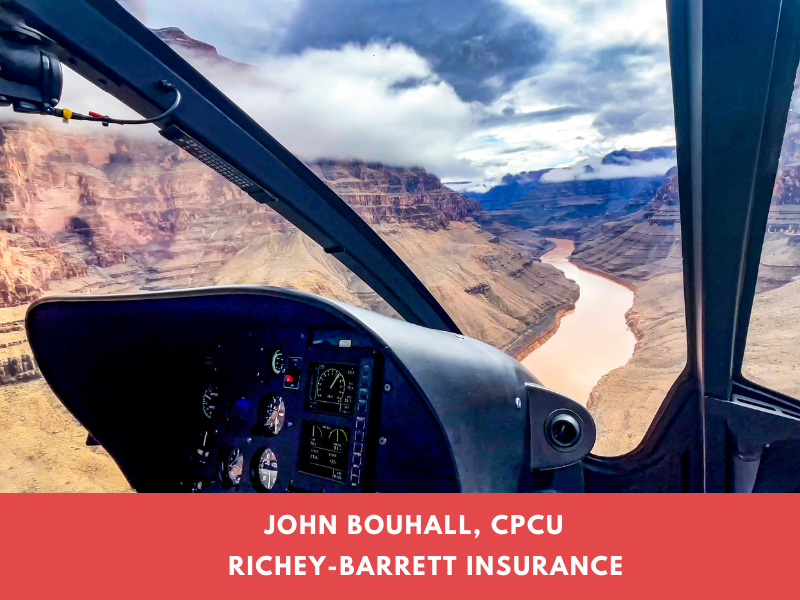
If you are adventurous and comfortable with heights, then a helicopter tour may be the “looking for something new to do” vacation experience for you. Tours are available right here in Cleveland, OH, with additional popular sites within driving distance. What I call the “super sights” likely require air travel. Price ranges and helicopter tour packages vary. Do your homework and/or contact a qualified travel agent.
A certified and reputable helicopter tour operator needs liability insurance to operate, which is available through the specialty aircraft aviation market. There is some interesting history here that to some degree reflects cultural and societal norms. Years gone by, when airspace wasn’t so crowded and common sense safety measures were enforced across-the-board, helicopter tour operators could purchase multi-million dollar liability limits beyond their dreams. Pricing was cheap relative to the limits provided. In theory, these huge liability limits would never be penetrated. A catastrophe of this stratosphere was unimaginable, literally. All that has changed.
Crowded airspace. This is an ongoing issue, including the airspace where some helicopter tours fly. In January 2025, crowded airspace went from a catastrophe waiting for a happen to an unbelievable, mid-air collision near Reagan Washington National Airport between a commercial jet and a U.S. military helicopter. In addition to 67 lives needlessly lost, the entire claims process is expected to consume 5+ years and cost more than $1 billion. Too much air traffic allowed to occupy too small of a space is a basic, common sense, safety issue.
Aircraft maintenance, pilot training, weather monitoring. These are all common sense risk management protocols. A well-maintained helicopter subject to routine maintenance checks is the first line of defense in reducing risk. Helicopter tour pilots should be properly certified, receive ongoing training, and clearly communicate to passengers safety and emergency instructions. Often dismissed or underrated is the consequential role a helicopter tour pilot’s judgment and temperament plays with respect to flying in dangerous conditions. This is especially applicable to what I term “super sights”, i.e. Hawaii, Alaska, The Grand Canyon. Three realities reflect our culture’s absurd immersion in “you can’t make this up”:
- Relentlessly demanding and rude customers have lashed out at level-headed pilots who will not fly a helicopter tour on a planned route due to rapidly changing weather patterns.
- Relentlessly demanding and rude customers have pressured helicopter tour pilots to risk it and fly toward the volcano they came to see that is surrounded by poor visibility.
- Pilots willing to get up close or fly too low to show off an attraction, stupidly violating regulations and/or their capability to safely perform a correction maneuver.
Human behavior. Tourists are normally excited or nervous before boarding a helicopter tour. Identification of risk begins with ground staff, who should be trained to recognize passengers under the influence. Once inflight, passengers who ignore safety instructions (such as unfastening seat belt to take a selfie or dangling feet outside of a “doors off” helicopter), contribute to pilot distraction, which raises the risk of accidental pilot error. Managing passenger behaviors should be part of pilot training, including role-playing exercises of various scenarios.
Risk management applies to any activity. It begins with common sense, i.e. avoid a kitchen fire by tending constantly to the frying pan. Businesses of all types, including insurance, use risk management to identify, assess, and mitigate uncertainty and threats. Reasonably employed, risk management allows us to expand our horizons with a sense of what the consequences may be.
It’s summertime. Safety on and wheels up!
Your Trusted Choice Independent Insurance Agents at Richey-Barrett Insurance wish you a safe and fun summertime.


