
Cutting Corners Could Collapse Your Tent
Read about general requirements trade contractors must adhere to in order to work in Ohio.
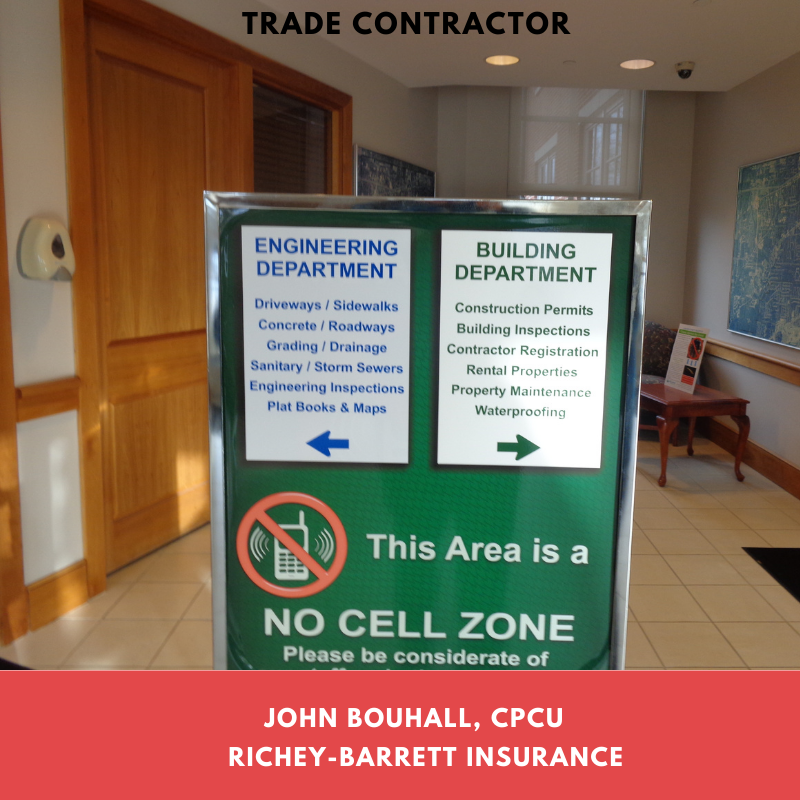
Learn why trade contractors need to understand state and local requirements before working.
Trade contracting is a big tent term. Even the lone handypersonperforming minor repair work for a fee may be considered a contractor. It is the responsibility of every trade contractor to follow the laws and requirements of each jurisdiction in which they operate. Cutting corners to save time or money in the short run could collapse your own tent.
The following outline is general and illustrative in nature. Actual state and local laws, codes, and regulations apply. The terms,conditions, and limits of actual insurance policies and bonds apply.
1. Registration and/or License Requirements:
Many local governments in Ohio require contractors to register and/or submit an application for work planned to be performed. Fees are commonly charged.
Examples of work to be performed could be anything from handyperson jobs, to insulation, landscaping, snowplowing, carpentry, window and door installation to electrical, plumbing, HVAC, fire protection, hydronic, or refrigeration. The state of Ohio requires specialty contractors engaged in electrical, plumbing, HVAC, fire protection, hydronic, or refrigeration have a valid Ohio license.
Whatever contracting work you plan to do, check first with both the state of Ohio and the specific localities in which your potential jobs are located before beginning any work. Abide by all local regulations pertaining to plan approval, permits, inspections, maintenance of job site, and any other specific requirements.
Failure to comply with applicable state and local laws, codes, and regulations may result in fines and penalties, jail, and/or possible shutting down of the job.
2. Insurance Requirements:
– Proof of contractor’s general liability insurance. The minimum limit requirement for each locality varies; be sure you are in compliance.
– Proof of Ohio Bureau of Worker’s Compensation Insurance, if applicable.
– Proof of automobile liability insurance. The minimum limits required may exceed the statutory limits in the state of Ohio.
3. Bond Requirements:
Depending on the type of work and/or the local governmental entity, trade contractors may need to be bonded.
– A license and permit bond protects consumers and governments by guaranteeing that the contractor will perform the contracted tasks in compliance with the laws, codes, and regulations of the applicable governmental entity. If a claim is made that the contractor has failed to perform accordingly, and an investigation determines that the contractor failed to perform accordingly, the bonding company pays the additional costs necessary to bring the job into compliance. The bonding company has legal recourse to collect the full amount of the claim from the contractor, including interest and expenses associated with the investigation of the claim.
– A bid bond guarantees that the bidder (contractor) has the financial capability to perform the job for the price quoted in the bid. Bid bonds are very common in public construction projects.
– A performance bond replaces a bid bond when a contractor’s bid is accepted, and the contractor proceeds to work on the project. If the contractor’s work is defective or not up to standard, the project owner may make a claim against the performance bond, which would cover the cost of redoing or correcting the job.
– A payment bond (sometimes referred to as a wage and welfare bond) is frequently required in conjunction with performance bonds. It guarantees that the contractor will pay all workers, sub-contractors, and material suppliers per contractual obligations.
Richey-Barrett Insurance is your Trusted Choice Independent Insurance Agent for Trade Contractor’s Insurance and trade contractor bonds.


